
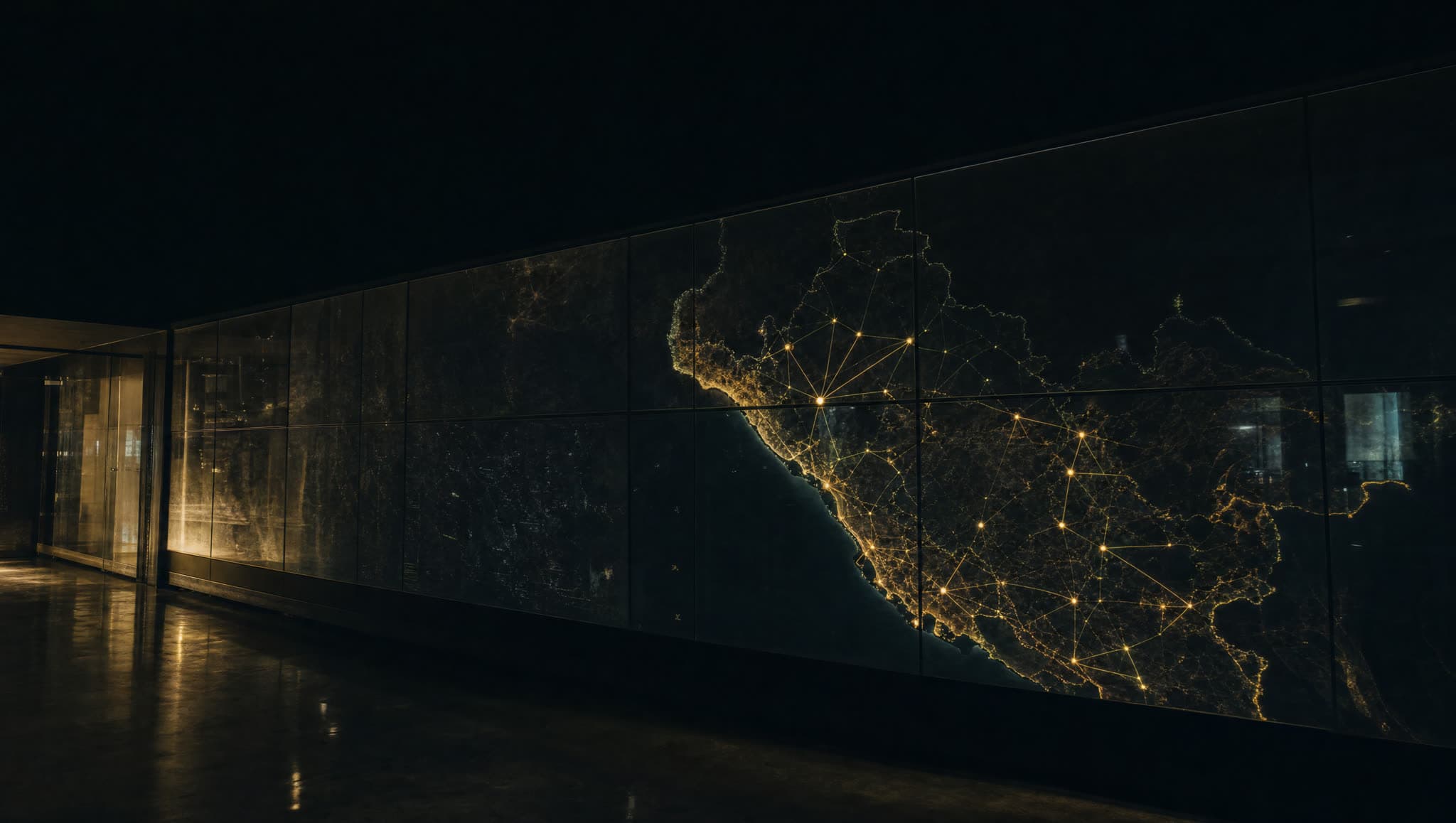
El hipergrafo institucional es la knowledge graph layer civilizacional, multi-hyperedge data structure unificando entities (nodos humanos, projects, papers, patents, capital flows, capability vectors) bajo single ontology con sovereign infrastructure (no Palantir, no Salesforce, no third-party SaaS gatekeeping). El stack 2026+ permite construir esta capa con equipo de 8 a 12 personas en 18 meses sobre Neo4j Enterprise + GraphRAG + LLM-driven entity resolution, frente al modelo team-grande-36-meses que era estándar en la era pre-LLM. Capex acumulado 10 a 25 millones, no 30 a 60. Comparable: Palantir Foundry ($30B+ market cap, NSA + Pentagon contracts), Quid + Recorded Future intelligence platforms. Civilizational version: open-source kernel (RDF+SPARQL o property graph Neo4j-compatible) operacional sobre #14 Plataforma compartida inter-corporativa infrastructure, con #03 Sirius como primary application layer. Ownership: ningún hyperedge cruza fuera de jurisdicción civilizacional sin explicit consent gate.
Por qué hipergrafo: limitaciones de graph binario
Graph clásico (RDF triple, Neo4j relationship): edges binary (source→target), insufficient para multi-entity relationships típicas de civilizational data. Hyperedge: edge connecting N entities simultaneously, example: "Paper X cites Paper Y in context of Topic Z, funded by Grantor W, authored by Researchers A,B,C affiliated with Institutions M,N", single hyperedge captures 8-way relationship vs 7+ binary edges con context loss. Mathematical foundation: Berge 1973 hypergraph theory. Computational: Neo4j 5.0+ supports compound relationships, Stardog (RDF + reasoning) maturest commercial, AnzoGraph (open-source GraphQL hypergraph). Performance: hypergraph traversal complejidad O(V·E·k) where k=hyperedge cardinality, vs O(V·E) binary, 5-10x compute overhead, justified por semantic fidelity.
Ontology civilizacional: 7 entity classes
Schema design. (1) Operator (sirius_id namespace): individual, capability vectors, employment history, project ownership, language stack, geographic location. (2) Project: frente assignment, phase, capex, timeline, deliverables, dependencies. (3) Knowledge artifact: paper (DOI), patent (USPTO/INPI), code repo (GitHub/GitLab URI), dataset (DOI). (4) Institution: company, university, lab, government agency. (5) Capital flow: investment round, grant, contract, equity transfer. (6) Capability: discrete skill atom ("CRISPR-Cas9 design", "Rust embedded", "Quechua NLP"), capability inheritance hierarchy. (7) Geographic node: city, region, country, biosphere zone. Hyperedges: 50-100 typed relationships connecting 2-8 entity classes simultaneously. Schema versioned semver (v1.0 → v2.0 breaking changes), backwards-compatible reasoning over multi-version data.
Stack: graph DB + reasoning + governance
Storage layer: Neo4j Enterprise (commercial license, multi-region active-active replication) o open-source alternative ArangoDB (multi-model: graph + document + key-value, AGPL license). Reasoning layer: SPARQL 1.1 + custom DSL para civilizational queries ("find all human nodes capable of X within Y latency from Lima"). Indexing: pgvector embeddings sobre human node capability descriptions, semantic search complementario a structured query. API: GraphQL endpoint sirius.kiranir.com/graph, OAuth 2.0 + Magic Link auth, jurisdiction-aware response filtering (human node data restricted to authorized cohort). Sovereignty: hosted on Lima data center #14 Plataforma compartida inter-corporativa infrastructure, encrypted at rest AES-256, TLS 1.3 in transit, no data egress to non-civilizational infrastructure. Backup: distributed across #20 Infraestructura orbital lunar datacenter (geographic + extraterrestrial redundancy).
Aplicaciones: Sirius + frentes integration
(1) Sirius detection: graph traversal automatically surfaces human nodes whose capability vectors match emerging frente requirements (#02 Genómica andina opens, query "human nodes capable of Lindo 2018 ancient DNA protocol + Quechua Spanish bilingual + Lima-locatable" returns ranked candidate set). (2) Capability gap analysis: civilization-wide capability inventory, identifies gaps preventing frente progression, gap fill via #25 Diáspora técnica recruitment or #22 Bio-foundry distribuido training pipeline. (3) Capital allocation: capital flow hyperedges visualize where investment compounds vs dissipates, inform LP capital calls. (4) IP defense: patent + paper + code provenance tracked, civilizational IP inventory protectable via #13 Capa pagos jurisdiction selection. (5) Knowledge synthesis: hyperedge traversal enables AI-assisted research synthesis (claude-opus model querying civilizational graph + external corpus, civilizational-aware response generation).
Cronograma + deployment milestones
Fase 0 (2026-2027) build inicial (18 meses): equipo nuclear de 8 a 12 personas (lead graph engineer + 3-4 backend engineers + 2 ML/RAG engineers + 1 ontology designer + 2 data engineers + 1 security/governance), primary schema v1.0 estabilizado con 7 entity classes + 50 hyperedge types, integración LLM entity resolution sobre Claude o Mistral fine-tuned, initial population from #25 Diáspora técnica + Sirius cohort 01 data. Hosting: dual Lima primary + cloud backup (AWS sa-east-1 São Paulo hasta que #14 Plataforma compartida inter-corporativa datacenter operativo). Capex 4 a 7 millones. Fase 1 (2028-2030) production: full sovereignty migration to civilizational datacenter #14, schema v2.0 con expanded ontology (capability hierarchy + project dependency graph), AI-assisted query layer (Claude API integration). Capex 5 a 12 millones acumulados. Fase 2 (2030+) extension: hypergraph extension to #20 Infraestructura orbital lunar datacenter (geographic + extraterrestrial redundancy), IP defense formalization (patent inventory dashboard, jurisdiction selection automation), multi-civilization graph federation si SOLAR consortium operativo. Total acumulado 10 a 25 millones, frente a 30-60 del modelo team-grande clásico.
Análogo: ARPANET 1969
ARPANET (DARPA-funded, deployed 1969 BBN UCLA-SRI link Oct 29 1969): primera red de cómputo packet-switched financiada por defensa, designed para survive military node loss vía packet-switched routing. Critical decision: TCP/IP open protocol stack (Vint Cerf + Bob Kahn 1974) prevented vendor lock-in, enabled global Internet emergence 1990s. Inverse case: France Minitel (1982-2012), closed national network, no interoperability, eclipsed by open Internet by 2000s. Civilizational hipergrafo balances: open-source kernel (interoperability, talent attraction) + sovereign hosting (jurisdiction control, data egress prevention). Risk: if Palantir or Salesforce captures civilizational data via SaaS dependency (analog Minitel-state-capture), sovereignty lost permanently, counter via in-house infrastructure investment Phase 1 mandatory, no extension of cloud dependencies post-2030. Quien controla la knowledge graph controla la civilización.